Venezuela latest: US in 'active pursuit' of third vessel off Venezuelan coast, officials say

It comes after video footage on Saturday showed an oil tanker being seized near the Venezuelan coast in an operation confirmed by the Department of Homeland Security. Last week, the US first seized a sanctioned oil tanker, called Skipper, off the coast of Venezuela.

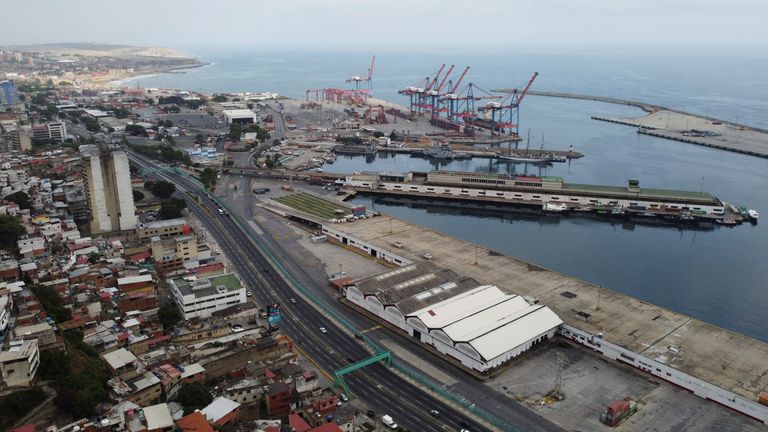
Venezuela's Bolivariana de Puertos La Guaira port. Pic: Reuters
Image: Venezuela's Bolivariana de Puertos La Guaira port. Pic: Reuters
Why you can trust Paste BN
We're pausing our coverage - thanks for following along

 This has been our rolling coverage of the third attempted interception of a Venezuelan-linked vessel by US forces within less than two weeks. It was also the second one this weekend.

After seizing the Centuries yesterday, US Coast Guard forces were today chasing the Bella 1, a sanctioned tanker linked to illicit Venezuelan oil trade.

As of now, the status of this "active pursuit" remains unclear, but a seizure has not been officially reported.

You can watch footage of yesterday's successful seizure in the video:

Donald Trump pledged this week "A TOTAL AND COMPLETE BLOCKADE OF ALL SANCTIONED OIL TANKERS" as his government has accused Venezuela's president, Nicolas Maduro, of running a drug cartel. 

The US pressure campaign has also included strikes on so-called 'drug boats' and a military build-up off Venezuela's coast. 

Previous comments from the administration suggested the goal could be to oust the authoritarian leader and take advantage of Venezuelan oil reserves.

Watch: What is behind interceptions of tankers carrying Venezuelan oil?

'Venezuelan barrels at risk': Will tanker seizures impact the oil market?

Venezuela is sitting on the world's biggest reserves of heavy oil, alongside Canada and Russia.

One oil trader told Reuters that the repeated seizures of tankers linked to Venezuelan oil may push oil prices higher when Asian trading resumes tomorrow. 

"We might see prices increasing modestly at the opening, considering market participants could see this as an escalation with more Venezuelan barrels at risk," Giovanni Staunovo of UBS said. 

As the cost of living remains a concern for Americans, the White House downplayed the risk of higher prices.

The director of the White House's National Economic Council, Kevin Hassett, told CBS today that the first two oil tankers seized were merely affecting small parts of illicit trade.

"I don't think that people need to be worried here in the US that the ‌prices are going to go up because of these seizures of these ships," ⁠he said.

However, Matias Togni, an oil shipping analyst at NextBarrel, said the impact on shadow-fleet trade could get bigger as seizures may encourage Ukrainian attacks on Russian shadow-fleet vessels.

Intercepted tanker identified as 'Bella 1' - reports

We can now bring you more on the latest US attempt to seize another vessel near Venezuela.

The vessel has been identified by several American media as Bella 1, a crude oil carrier that is on the US sanctions list.

It was sanctioned under counterterrorism authority for its involvement in the network of Houthi financial facilitator Sa’id al-Jamal, our US partners NBC News reported. 

Bella 1 has previously transported Venezuelan oil to China and carried Iranian crude, according to Reuters.

It had not loaded any oil, however, when it was approaching Venezuela, according to the news agency, which cites a specialist tracking site.

The New York Times reported that the vessel didn't submit to being boarded, leading to today's "active pursuit", that US official referred to earlier.

Citing three US officials, it also said Bella 1 wasn't flying a valid national flag, making it a stateless vessel that can be boarded. The warrant for the seizure was sought by authorities over its involvement with Iranian trade, according to the newspaper.

The current status of the operation remains unclear. Bloomberg reported the pursuit was still ongoing around 6pm UK time.

Major US reward for Maduro's arrest amid tanker blockade

The US has been offering a reward of $50m for the arrest of the Venezuelan president as of this year, as it has increased the pressure with a "blockade" of sanctioned oil tankers.

Nicolas Maduro denies the US accusations against him that include:

  • Narco-terrorism conspiracy
  • Cocaine importation conspiracy
  • Conspiracy to use and carry machine guns and destructive devices in furtherance of a drug crime

In Donald Trump's first term, the US was offering a $15m reward, before increasing it to $25m and then to $50m in August.

The US claims:

"Maduro helped manage and ultimately lead the Cartel of the Suns, a Venezuelan drug-trafficking organization comprised of high-ranking Venezuelan officials. As he gained power in Venezuela, Maduro participated in a corrupt and violent narco-terrorism conspiracy with the Revolutionary Armed Forces of Colombia (FARC), a designated Foreign Terrorist Organization.  Maduro negotiated multi-ton shipments of FARC-produced cocaine; directed the Cartel of the Suns to provide military-grade weapons to the FARC; coordinated with narcotics traffickers in Honduras and other countries to facilitate large-scale drug trafficking; and solicited assistance from FARC leadership in training an unsanctioned militia group that functioned, in essence, as an armed forces unit for the Cartel of the Suns."

However, Maduro claims that the US wants to oust him and Venezuelan officials say Trump is after the country's oil reserves.

Maduro, who has been president since 2013, has been accused of being a dictator who has cheated in elections and is not the recognised leader of Venezuela by much of the West.

What is behind interceptions of tankers carrying Venezuelan oil?

Today's "pursuit" of a vessel near Venezuela was the third US interception of a tanker carrying Venezuelan oil in less than two weeks - and the second this weekend.

What's behind this US intervention, which goes hand in hand with strikes on 'drug boats' and a military build-up?

Our data and forensics correspondent Tom Cheshire has analysed this and how it's linked to Venezuela's oil reserves.

Watch his summary of this weekend's event here...

Explained: Who is Nicolas Maduro and why is he clashing with the US?

As we've reported in our post at 16.38, the US aggression against Venezuela may well be an attempt to oust Nicolas Maduro.

But who is Venezuela's authoritarian, tracksuit-clad leader?

Maduro's background in brief:

  • Maduro has been Venezuela's president since 2013, taking over after Hugo Chavez, the populist left-wing president and Maduro's mentor, died;
  • Maduro started his working life as a bus driver, then became a union leader and later served as Chavez’s foreign minister and vice-president.

Why is Maduro so unpopular?

  • Maduro never matched the popularity of Chavez, who was charismatic with a natural common touch.
  • Venezuela's economy collapsed under Maduro after years of Chavez's economic mismanagement, including price controls and handouts that drained the state's oil-dependent funds;
  • When oil prices fell in the 2010s, food and medicine imports became unaffordable. Money printing caused hyperinflation, rendering the currency worthless. Corruption and international sanctions increased the pressure.
  • Maduro responded with repressions to dissatisfaction. He has brutally cracked down on repeated mass protests and was accused of rigging the 2018 and 2024 elections;
  • More than a quarter of the population - some 8 million people - have immigrated.

Why is Maduro clashing with the US?

  • Chavez's and Maduro's hard-left 'Bolivarian revolution' ideology rejects American capitalism and hegemony and brands the US an imperialist power;
  • The US criticises Maduro's political repression and denies his legitimacy after election manipulation accusations in 2018 and 2024. It recognised the opposition candidates as legitimate president-elects;
  • US governments have long accused Venezuela of failing to cooperate with anti-drug efforts over domestic criminal groups;
  • Trump has gone further. He blamed Maduro for Venezuelan immigration to the US, accused him of stealing US oil as the country nationalised its industry from 1976. He has alleged that he is himself a cartel leader. Maduro denies this.
Latest tanker interceptions come after new US sanctions against Maduro family

This weekend's tanker interceptions notably come on the back of the US imposing new sanctions on Nicolas Maduro's family members.

On Friday, the Treasury Department announced sanctions against Maduro’s sister-in-law and relatives of his nephew, Carlos Erik Malpica Flores.

The latter is among three of Maduro's nephews who were added to the US Treasury's sanctions list last week. 

The other two are Francisco Flores de Freitas and Efrain Campo Flores, who were dubbed the "narco nephews" for attempting to transport 800kg of cocaine into the US.

They were arrested in Haiti in 2015 in a sting operation from the US Drug Enforcement Administration and sentenced to 18 years in jail in 2017. 

They were granted clemency in October 2022 as part of a prisoner swap for Americans detained in Venezuela. 

The nephews are related to the Venezuelan president through his wife, Cilia Flores.

The strikes that led to us getting here

Aside from seizing tankers, the US has been carrying out repeated strikes on what it claims are drug boats. Our data and forensics correspondent Tom Cheshire has analysed the patterns of previous strikes...

On 2 September, the White House posted on X that it had conducted a strike against so-called "narco-terrorists" shipping fentanyl to the US, without providing direct evidence of the alleged crime (watch the video below).

Sky's Data & Forensics unit has verified that between September and 12 December, 23 boats have been targeted in 22 strikes, killing 87 people.

The latest was on 4 December, after which US Southern Command announced it had conducted another strike on an alleged drug smuggling boat in the eastern Pacific.

It was the first such strike since 15 November and since the defence secretary, sometimes referred to as secretary of war, Pete Hegseth, came under scrutiny for an alleged "second strike" in an earlier attack.

The US says it carried out the action because of drugs - and there has been some evidence to support its assertion.

The Dominican Republic said it had recovered the contents of one boat hit by a strike - a huge haul of cocaine.

Note: Since 12 December, the US military has said it carried out strikes on five more boats, killing over 100 people.

Recap: How the US seized the first oil tanker off the coast of Venezuela

Earlier this month, the US seized an oil tanker off the coast of Venezuela for the first time since the start of its aggression against the government in Caracas.

Donald Trump confirmed the seizure to reporters at the White House, escalating tensions between Washington and Caracas.

Using US forces to seize an oil tanker is highly unusual and marks the latest push by the Trump administration to mount pressure on Venezuela's government.

US Attorney General Pam Bondi shared a video of US troops executing a seizure warrant on the crude oil tanker.

The footage shows a helicopter hovering just a few feet above the ship as forces quickly descend on ropes.

Watch: Moment US seizes oil tanker

The troops dressed in camouflage uniforms can be seen storming across the deck, armed with large firearms, before pointing their weapons at a door and entering.

The video, likely recorded from another helicopter, also shows forces running upstairs to the bridge as others move throughout the superstructure of the ship.

Bondi confirmed that the FBI, Homeland Security, US Coast Guard, and Department of Defence were involved.

The US Coast Guard team included elite forces trained in high-risk boarding from the Maritime Security Response Teams, which specialises in maritime counterterrorism and counternarcotics, according to two US officials.

Active-duty US military soldiers were also involved in the seizure. Although they were not permitted to board the tanker as they were deployed on Title 10 (active duty) orders, they aided with overhead surveillance and helicopter transport, the officials said.

Trump hasn't ruled out war with Venezuela

Donald Trump has previously sent ambiguous signals about whether his military build-up near Venezuela is the start of a greater military intervention.

But notably, he expressly left the possibility of a war with Venezuela on the table in a phone interview with our US partners NBC News.

"I don’t rule it out, no," he said.

When he was asked whether he rules out the possibility that the US strikes on alleged drug boats and tanker seizures could lead to war, he said: "I don't discuss it."

Trump also declined to say whether ousting Maduro was his ultimate goal.

"He knows exactly what I want," Trump replied. "He knows better than anybody."

The comments are notable as Trump has long campaigned on being able to keep the US out of foreign conflicts.