Agri deal plants corporate China firmly on global stage
The $43bn takeover of Syngenta is the latest and biggest example of China flexing its financial muscles on overseas investments.

Friday 5 May 2017 13:55, UK
A landmark has been reached in the story of China's international expansion.
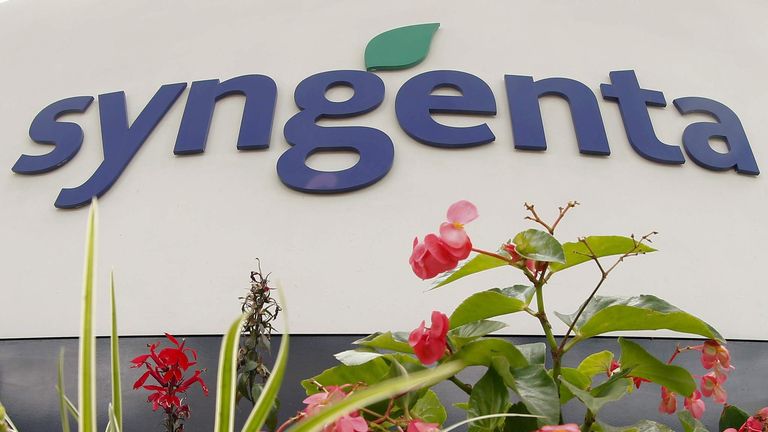
Shareholders in Syngenta, the Swiss agrichemicals giant, have given their blessing to a $43bn (£33bn) takeover of the pesticides and seed technology company by ChemChina.
The deal, which has already been given the green light by American, EU and Australian competition regulators, marks the biggest ever overseas takeover by a Chinese company.
It is further proof of China's ambition to establish itself and its companies - ChemChina is state-owned - on the international stage.
Chinese companies spent almost $240bn last year on overseas investments; a record, taking its cumulative spending since 2005 to an astounding $1.5tn.
Britain has been a major beneficiary of that spending, with Chinese investment ranging from relatively trivial but nonetheless eye-catching deals such as buying four of the six major West Midlands football clubs - Wolves, West Brom, Aston Villa and Birmingham City - to more meaningful transactions such as its involvement in the new Hinkley Point 'C' nuclear power plant and a stake in the UK's national gas pipeline network.
The UK's openness to Chinese investment has often aroused scepticism in other countries due to suspicions over, for example, counterfeiting and industrial espionage by Chinese agencies, businesses or individuals.

But the Syngenta deal is striking because it shows other countries are now starting to show the same degree of openness.
Syngenta carries out a lot of secretive and sensitive work and is also a world leader in its field of which Switzerland is proud.
It employs 28,000 people in 90 countries around the world, including getting on for 2,000 here in the UK, at Cambridge, Grangemouth, Guildford, Huddersfield, Berkshire and Didsbury, Manchester, where it opened a new global operations centre in March last year.
That is a reflection of its history here in the UK - Syngenta was formed from the merger in 2000 of Novartis Agribusiness and the agrochemicals arm of Zeneca, once part of ICI, a stalwart of British industry.
Those people are in for an interesting time as they adapt from being employed by a Swiss-based multinational to an arm of the Chinese government.
The deal had been opposed by some politicians and consumer groups and, in order to get the deal past US regulators, ChemChina had to agree to sell paraquat, one of the world's best-known pesticides.
Another striking aspect of the takeover is what it tells us about China's attitudes towards its ownership of overseas assets.
For many years, the country was content to harvest the vast amounts of foreign currency it was earning into US Treasuries, an ultra-safe but ultra-dull asset providing little financial income.
Now it wants to buy assets that will provide positive benefits to it and its people.
That will include buying assets that it believes can provide it with a decent financial return, such as its investment two years ago in Pirelli, the Italian tyre manufacturer.
However, in buying such assets, China is also thinking strategically.
Pirelli, for example, will give it insights into the production of tyres, a product, if ever there was one, that will be in greater demand in China as the country gets wealthier and more people buy cars.
Syngenta is a good example of that.
It will give China the means to boost its agricultural output as it moves away from inefficient peasant farming methods towards bigger and more mechanised production.
That was already under way, as during the last decade, China has seen a mass movement of people giving up farming and moving away from the countryside to the cities.
However, due to the relatively rudimentary nature of its agricultural sector, China has struggled to feed its own people and especially to meet growing demand for foodstuffs such as meat and dairy produce as it becomes wealthier.
Syngenta, with its expertise in areas such as genetically modified crops, will enable China to feed itself more effectively.
There is one other aspect to this deal of interest: it marks the growing concentration in the global agrichemicals sector.
Aside from the Syngenta takeover, Bayer of Germany is in the process of buying US group Monsanto for $66bn, while American giants Dow Chemical and DuPont are in the process of putting together a $145bn merger.
These deals mean that just three companies will, in future, have a huge share in producing agrichemical products, such as fertilisers and genetically modified seeds, on which the world's food production will increasingly depend.
Some people may find that disconcerting.