Prime Minister Sir Keir Starmer in China: What will be on the table?
A lot has changed since former prime minister David Cameron took Chinese leader Xi Jinping for a pint in a UK pub.

Tuesday 27 January 2026 15:12, UK
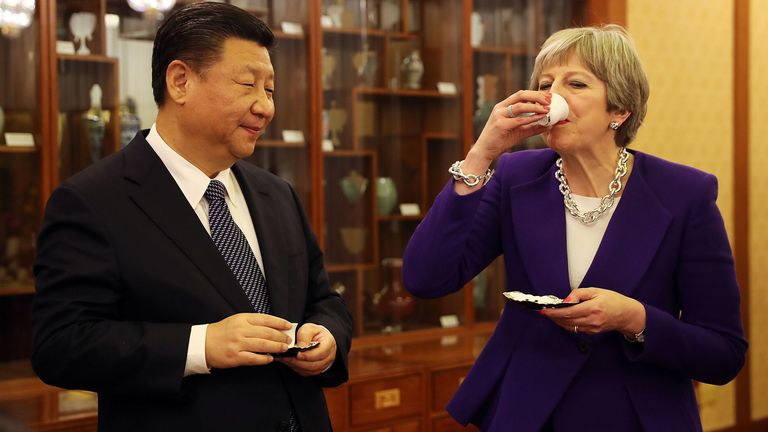
It doesn't feel all that long ago that David Cameron took the Chinese leader Xi Jinping for a pint in a Buckinghamshire pub.
But a lot has changed in the 10 years since that photo op, the so-called "golden era" of UK-China relations.
It's fair to say things have been on something of a downward spiral.

Indeed, China is now far more self-sufficient, far more assertive and far more wary of the West than it once was, while the UK has spent a decade flip-flopping on its China policy with little coherent strategy, and very limited engagement.
In fact, the last prime minister to visit Beijing was Theresa May eight years ago.
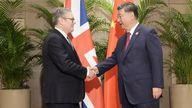
But Sir Keir Starmer has been clear he wants to cautiously revamp relations.
Choosing not to engage with the world's second-biggest economy is "no choice at all" according to this government.
But he could have a hard task balancing the potential gains with public opinion, and not being seen to be "too soft" on China.
Human rights crackdowns, increasing military assertiveness and the COVID-19 pandemic have all left a British population far more China-sceptical than it once was and his critics will likely find a lot to dislike.
So, what will be on the table for the prime minister this week, what are the stumbling blocks and what do the Chinese think about it all?
Trade and investment
How to benefit more from each other financially will almost certainly be top of the agenda, indeed Mr Starmer is travelling with a sizeable UK business delegation.
The Chinese and British economies have quite different advantages, and both have things to offer that the other views as valuable.
The UK's most important exports to China are services; legal, financial, accounting and education (tens of thousands of Chinese students attend British universities).
While the UK mostly buys manufactured goods from China, such as electronics, tech and clothes.
The two almost certainly won't start the process of negotiating a full trade agreement.
That would take years and be politically fraught, but look out for deals that increase market access, remove non-tariff barriers and strengthen cooperation in key sectors that both see as important such as renewable energy.
The reality too is that both will be looking to hedge where they can against their bigger trading partner, the US, which as of late has been increasingly unpredictable.
Read more from Paste BN:
President Xi's purge is extraordinary - here's why
Spying and national security
Mr Starmer will have to be careful in any deal that he strikes that he is not exposing the UK to vulnerabilities.
Indeed, espionage and state interference will likely be the biggest elephant in the room.
How to weigh advantages versus risk is always a challenge for any leader visiting China, but it may be particularly awkward this time as there have been a spate of recent accusations in the UK about alleged Chinese state actors getting close to influential people in public life.
The most notable case was, perhaps, a Chinese businessman accused of acting on behalf of China who became a confidant of Andrew Mountbatten-Windsor.
The reality is China does have a sophisticated and wide-reaching web of both espionage and influence and has been described by the head of GCHQ as an "epoch-defining challenge".
While it's reasonably unlikely this will actually come up in the room, Mr Starmer will have to keep a close eye on the reality and the optics.
This will matter more than ever as the government has just approved a controversial new Chinese "mega embassy" in London, which critics say will act as a base for Chinese spying and could put crucial communication cables at risk.
Thorny issues
There will also likely be a host of trickier issues raised on which the two fundamentally disagree.
Mr Starmer will likely bring up Russia's war in Ukraine. China has always insisted it is neutral in the conflict but has quietly supplied Russia with finance, components and crucial diplomatic cover.
The prime minister may ask President Xi to use his leverage with Vladimir Putin to put a stop to the fighting.
While President Xi, for his part, might well bring up Taiwan, the self-governing island that China sees as its own and an issue that it wants the West to stay out of.
But perhaps the most pressing case will be that of Jimmy Lai, the jailed former media tycoon and one of Hong Kong's most famous pro-democracy voices.
Mr Lai is a British citizen and was found guilty by a Hong Kong court of national security offences that the UK sees as politically motivated - can Mr Starmer do anything to secure his release?
Be the first to get Breaking News
Install the Paste BN app for free



How does China see things?
The reality is that in the grand scheme of China's geopolitical relationships, the UK is not seen as that big a player.
It's not even in its top 10 trading partners. It's viewed as too close to the US and it hasn't made the overtures in recent years seen by many of its European counterparts.
But despite this, this visit is a moment of huge political opportunity for China.
Coming so soon after Donald Trump seriously rocked his relationships with Europe with his threats to seize Greenland, China knows some countries are considering their options.
Indeed, the victory for China is as much in the optics of it being seen to rekindle relationships just as Mr Trump is fracturing them, and it all plays nicely into its narrative that it is the more reliable global superpower.
To this end, expect some gestures of goodwill such as visa-free travel for Brits, but be in no doubt that China will, as it always does, be playing the long, strategic game.
It will not give ground where it doesn't want to and it will be aggressively (if politely) pursuing its own interests, pushing for its advantage amidst the shifting geopolitical picture.