Ukraine crisis: Security conference in Munich haunted by fear NATO could and should have done more
The allies' bet was the threat of non-military economic and financial sanctions would be enough to avert the invasion and destruction of a European democracy - but if US President Joe Biden is right about a looming attack, this strategy has failed.

Saturday 19 February 2022 23:35, UK

In a city forever associated with appeasement, of Germany before World War Two, the West gathered to try and achieve the opposite with Russia, a message of deterrence and unity.
The backdrop to their meeting in Munich was deeply worrying. Grim omens as the prime minister put it.
Everything is moving towards a Russian offensive.
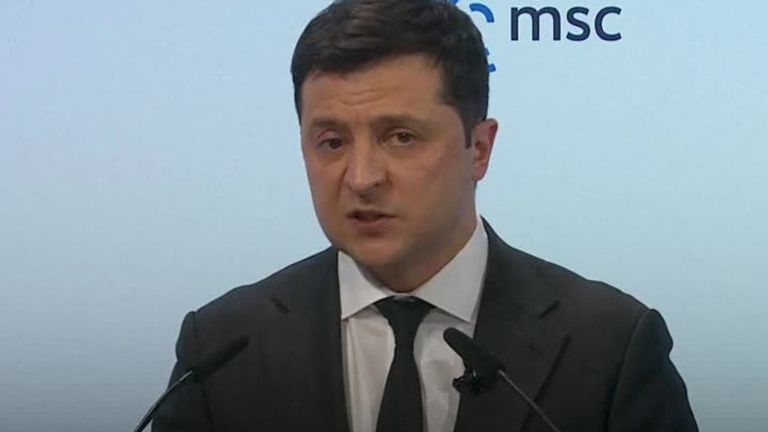
The Americans believe Vladimir Putin's chosen to invade even if Boris Johnson would not go that far when he spoke to Paste BN.
Protracted crisis could be in the works
Haunting the security conference here was the knowledge that even if an invasion is not imminent, a protracted crisis could be in the works.
The prime minister spoke of staged events, a web of falsehoods, fabricated withdrawals.

Western officials are now voicing concerns about a steady pattern of events designed to undermine and destabilise Ukraine and divide allies.
Each on their own is not sufficient grounds for the West to act. But taken together they cannot be allowed to stand.
They will need a strategic response. So far it is not clear what that will be.
A protracted crisis makes more sense than an invasion.
What is Putin's state of mind?
As one speaker after another has made clear in Munich, the cost to Russia from invading would be enormous in bodies and damage to the Russian economy. Vladimir Putin's legacy would be a pariah state with a basket case economy.
A rational actor would choose a protracted crisis. But what is Vladimir Putin's state of mind? Another question exercising minds in Munich.
He has been bunkered down through this pandemic.

We have seen him keep his distance even from his closest aides separated by those comically long desks and tables.
Western officials wonder if that has made him less rational, more suspicious, more paranoid, and delusional enough to believe invading Russian troops would be met with anything other than stiff Ukrainian resistance.
Fear NATO should have done more
Also haunting this conference is the fear the West and NATO could and should have done more.
The prime minister told the conference the destruction of a democratic state is at stake, and the principles of freedom and democracy.
Ukraine is not in NATO and subject to its all-for-one-one-for-all protection, Boris Johnson told Paste BN.
But the destruction of a democratic ally would do enormous damage to NATO and the world order it is meant to underpin.
Follow the Daily podcast on Apple Podcasts, Google Podcasts, Spotify, Spreaker
'An awkward question' remains
From Munich Conservative MP Tobias Ellwood told Paste BN: "There is, I'm afraid, an awkward question hanging here.
"Why does the might of NATO not have the ability to prevent a European democracy being invaded? And the answer is the fact that we are hiding behind the fact it is not a member."
The allies' bet was the threat of non-military economic and financial sanctions would be enough to avert the invasion and destruction of a European democracy.
The US president says he believes his Russian counterpart has already decided to invade.
If that is true, that strategy has failed. What next?