Secret ballot to be held on President Zuma as he faces no-confidence vote
Opposition to Mr Zuma has increased in recent years - but eight previous no-confidence votes have failed.
Tuesday 8 August 2017 03:51, UK

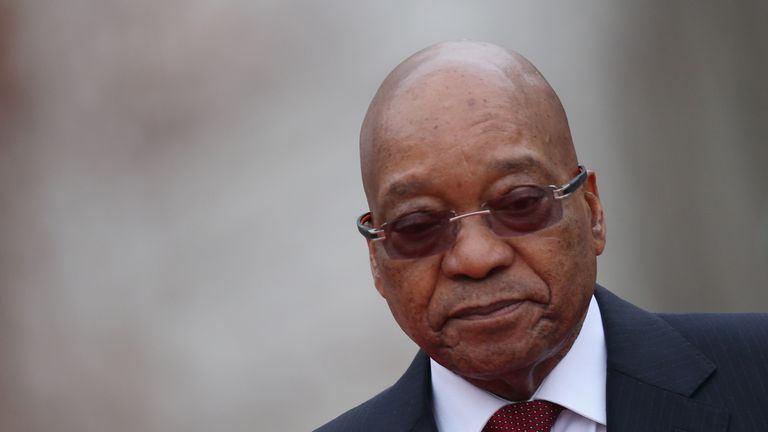
A no-confidence vote on President Jacob Zuma will be by secret ballot, the South African parliamentary speaker has said.
The motion was brought by opposition parties, and if Tuesday's secret ballot succeeds Mr Zuma and his cabinet would have to step down.
The results are expected this afternoon, and there is an opposition march set for 8.30am (UK time) in Cape Town, where parliament is located.
Opposition to the President has increased in recent years due to government corruption scandals, record unemployment and a weakening economy.
African National Congress (ANC) national chairwoman and parliamentary speaker Baleka Mbete said the decision to hold a secret ballot was to ensure the result was credible.
Eight previous no-confidence motions against Mr Zuma have failed - but they were all held via an open process.
The ANC, Mr Zuma's party, have vowed to back him in the vote and spokesman Zizi Kodwa called the motion "frivolous".



It would take 50 ANC members backing the opposition for the vote to succeed.
The President easily survived an impeachment vote in 2016 after South Africa's highest court ruled he had breached the constitution over government funds spent renovating his private home.
A public prosecutor's report made reference to non security-related improvements such as a cattle enclosure, amphitheatre, visitor centre, a chicken run and swimming pool.
Mr Zuma refused to pay any of the money back and commissioned his own report, where he said the swimming pool was a fire-fighting reservoir.
The court ordered him to repay some of the 240m rand (£11m) spent improving his residence and said the President had failed to "uphold, defend and respect" the constitution.
Mr Zuma said he would abide by the court ruling that he should pay some of the money back.
He has also been criticised for his closeness to the wealthy Gupta business family, and has been accused of granting them influence over government appointments, contracts and state-owned businesses.
Mr Zuma's controversial sacking of respected finance minister Pravin Gordhan in March also fuelled the anger of his opposition and shook South African financial markets.
The President's birthday celebrations in April also prompted large demonstrations, with protests being held at the same time as parties.