New Uber-backed driverless taxis to hit UK streets in 2026
The plan sets the scene for simultaneous trials by US and Chinese autonomous taxi giants in London, as the capital becomes the European centre of a self-driving revolution.
Monday 22 December 2025 14:58, UK
Uber and Lyft are both planning to launch driverless taxi trials in London in 2026, in separate partnerships with Chinese tech giant Baidu.
The move reinforces the UK's role as Europe's leading testbed for commercialising robotaxis, fuelled by the Automated Vehicles Act 2024 which provides a legal framework for driverless car liability.
It also sets the scene for the competing trials between US and Chinese autonomous giants for the first time in a European capital, following Alphabet-owned Waymo's recent start of supervised tests in London.
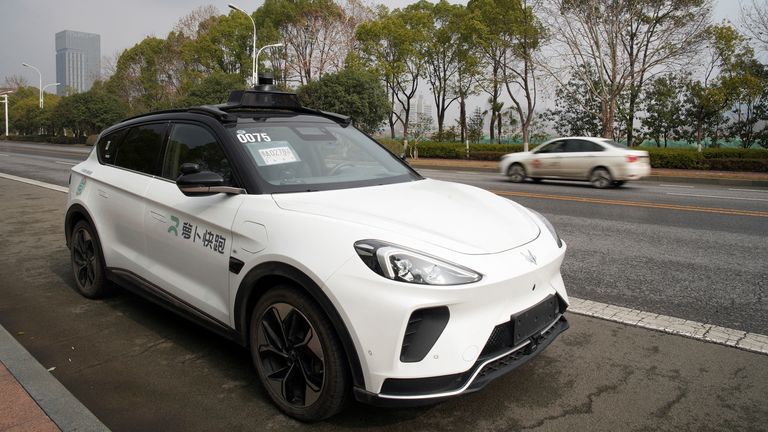
David Risher, Lyft's boss, revealed the company's trials would use Apollo Go RT6 vehicles that are "purpose-built for rideshare".
"We expect to start testing our initial fleet with dozens of vehicles next year - pending regulatory approval," Risher said.
The company "plans to scale to hundreds from there," he added.
Baidu is racing against rivals like Waymo, owned by Google parent Alphabet, whose cars have already been seen on London's streets.
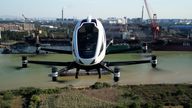
Fully autonomous UK trials are contingent on the government finalising driverless car regulations and giving companies the go-ahead to operate.
London-based start-up Wayve is also preparing to launch driverless trials in 2026, using investment of about $1bn (£750m) led by SoftBank Group and Uber, as it tests its "mapless" AI technology on London's complex streets.
London's new driverless car boom mirrors a broader global surge as Baidu and WeRide expand operations in the US, Middle East and Switzerland.
For Lyft, the UK trial serves as a cornerstone of its international expansion following its $200m (£148m) acquisition of the European taxi app FreeNow this year.
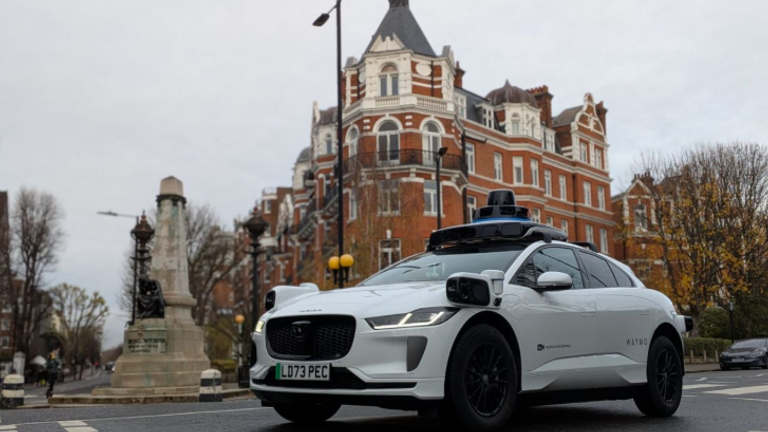
Driverless cars on the streets of London
London, often associated with the famous black cab, should see simultaneous tests of self-driving cars next year.
The UK's 2024 automated vehicles act shifted legal responsibility for incidents from the person in the car to the "authorised self-driving entity."
Self-driving taxis have become a regular feature on San Francisco's roads and recently launched in Tokyo.
Steve McNamara, general secretary of the Licensed Taxi Driver's Association told Paste BN in October that he wasn't currently concerned about competition with driverless taxis.
"It's a novelty, it is a gimmick. It is the solution that we don't need. Who needs a driverless cab?" he said.
He did not think Londoners would trust the taxis, let alone "put their kids in one to go to school".
Read more from Paste BN:
Trump's new Greenland envoy intends to make territory 'a part of the US'
Major incident declared as sinkhole drains canal and swallows narrowboats
In response, Waymo told Paste BN it "provides hundreds of thousands of rides every week in the US and shared in May of this year that we've provided over 10,000,000 fully autonomous rides to the public".
But releasing self-driving taxis hasn't come without bumps in the road.
In December 2024, a "dizzy" robotaxi passenger nearly missed his flight after his cab started driving around in circles.

Be the first to get Breaking News
Install the Paste BN app for free



A 2024 study also found that while self-driving cars are safer than those driven by humans most of the time, this wasn't the case when it is dawn, dusk, or the vehicle is turning.
During low-light conditions at dawn or dusk, they were more than five times more likely to have an accident than a car driven by a human.