Rosa couldn't figure out why her phone kept going missing just as she was leaving for work…
A mum-of-two tells Money how her ex was responsible for a string of unnerving events that left her £55,000 in debt and unable to get bank accounts or phone contracts - and exposes the traumatising fight with lenders that victims like her face to clear their name.

Saturday 24 January 2026 10:53, UK
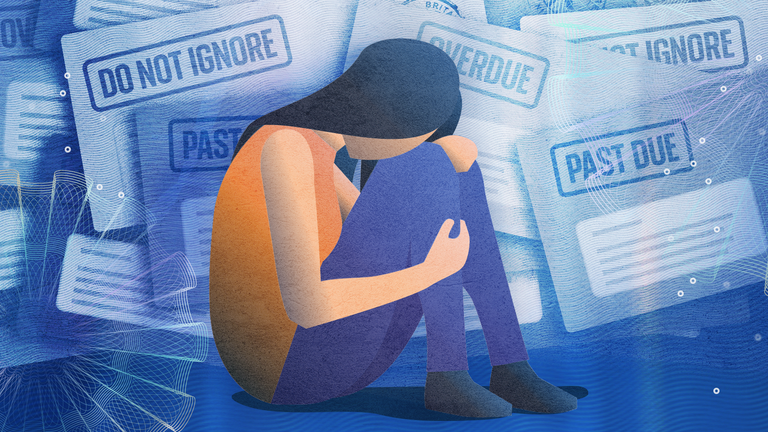
Rosa* couldn't figure out why her phone kept going missing.
Its regular disappearance just as she was leaving for work during the pandemic was the latest in a string of unnerving incidents: credit cards disappearing, passwords failing, her home burgled.
It took six months for the mum-of-two to discover her boyfriend was responsible, and that he'd been secretly racking up £55,000 of debt in her name. He'd even staged a fake break-in.
Money blog: Follow the latest consumer news
If that wasn't traumatising enough, Rosa then had to fight lenders for another two years to restore her credit record and for access to bank accounts, phone contracts and loans.
"The companies failed me," says Rosa, 44, a former teacher from northwest England, who battled with 11 lenders between 2020 and 2022.
"They were actually putting the blame on the victim and pretty much criminalising me."
Lenders forced her to prove her story over and over again with multiple departments, debt collectors, their complaints line and in some cases the Financial Ombudsman.
Responses varied dramatically between lenders and even between members of staff at any one organisation, Rosa says.
She is one of 1.6 million people faced with this system after being coerced into debt by a partner, family member or friend, according to debt charity Step Change.
It's a form of coercive and controlling behaviour, a criminal offence, that often occurs alongside other forms of domestic abuse.
An abuser may threaten or trick someone into taking out loans, borrow in their name behind their back or steal their money, forcing them into debt and tanking their credit score.
Their credit record means victims are then rejected when applying for mortgages, rental contracts and jobs in certain sectors.
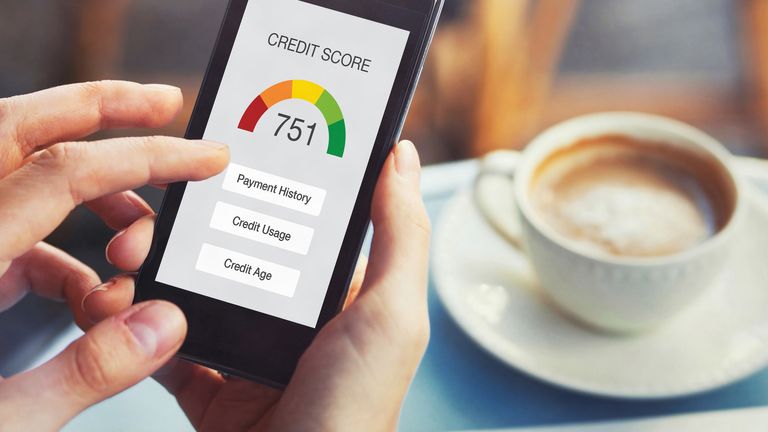
"They're cut out of the economy, out of housing, out of employment," says Deidre Cartwright, senior policy manager at the charity Surviving Economic Abuse (SEA).
"It prevents them from being able to leave a very dangerous abuser who can be a threat to their and their children's lives.
"If a victim-survivor is able to leave an abuser, it [credit score destruction] prevents her from being able to rebuild her life."
'Shocked and devastated'
"I was shocked and devastated that someone that I thought loved me could do those things to me," says Rosa.
"So to try and keep fighting and fighting to get all of that cleared was exhausting.
"I can see why lots of victims give up and try and repay it, because it takes far more effort to fight the companies and to clear your name."
Rosa's ex-partner began borrowing in her name without her knowledge more than a year into what she thought was an "amazing" relationship.
Passwords stopped working and payments were declined after he moved into her house in March 2020, during the first COVID lockdown.
He convinced Rosa there was a virus on her laptop and her phone had been hacked, and even changed the locks after fabricating a burglary.
In reality, he was cancelling her cards and intercepting new ones while she, a key worker, braved the pandemic, hiding her phone so he could use it to authorise payments and even impersonating her voice during calls to her bank.
Her wages were stolen each month and, unable to access her accounts or mail, she was unaware her mortgage and home insurance were in arrears.
Read more from Money:
'Halifax closed my 16-year-old's account - and won't tell me why?'
We intervene in reader's £300 tickets dispute with Viagogo
'My sister is on benefits and can't get online'
"I remember putting Blu Tack on the camera on my laptop because I was so paranoid of every account being hacked," she says.
That was until he tried to snatch her phone away while a bank clerk was explaining the thief must be inside her house.
"It was in that moment that I thought, 'it's you'."
In six months, he had tanked her credit score from "excellent" to "poor", leading her bank to close her account and making her ineligible for a savings account, overdrafts and mobile phone contracts.
Survivors must convince seven different lenders on average to clear their name of £23,000 in debt, according to Money Advice Plus data.
While there are pockets of good practice, many lenders crowbar economic abuse into generic vulnerability policies, creating a "painstaking, unstandardised, difficult process", says Cartwright.
"There's a real lack of understanding and awareness of what coerced debt is and what their response to it could be."
'The devil's in the detail'
As part of its financial inclusion strategy announced last month, the current Labour government became the first British government to name, define and commit to rectifying coerced debt.
Britain's lenders, biggest credit reference agencies (CRAs) and UK Finance, which represents 300 financial services firms, have been tasked with developing a new approach that enables victims to access the products they need.
But campaigners are demanding more urgency to stop victims paying the price for abuse.
"It will be some time," John Webb, head of consumer affairs at Experian, one of the CRAs, tells Money.
"We are really at a reasonably early stage in the process," he says.
"We'd be talking about fairly large-scale, industry-wide guidance and mechanisms. You'd need to have everyone coming on board."
He says Experian, Equifax and TransUnion have presented a proposal to lenders, which have jurisdiction over data on credit reports and deciding when a customer has experienced economic abuse.
The main sticking points are a standardised threshold and assessment method, an agreed mechanism for suppressing or removing credit history data, and how to avoid unintended consequences for victims.
Webb says coerced debt is "very tricky" to assess because lenders need to work out who applied for it and in what circumstances, what the money was spent on, whether it was part of wider abuse and what response is best for victims, often without police reports to help.
"Financial services firms are committed to supporting victim-survivors of economic and financial abuse and have a wide range of support available," UK Finance says.
"We know that there can be complexities in helping victims regain control of their finances, and there is more to be done.
"We are committed to playing our part to deliver effective collaboration and action across government, regulators, and the private sector, which helps empower victim-survivors to reach their financial goals and achieve financial freedom."
While SEA is "very supportive" of this work, it has called for greater urgency and warned that guidance alone may not have enough teeth to ensure lenders standardise their approach to victims like Rosa.
"The devil's really in the detail. How will the Treasury actually be facilitating this collaboration? How will they be holding lenders and credit reference agencies to account?" says Cartwright.
"Will they be considering the need for guidelines, regulatory or legislative reform rather than just depending on the goodwill and good practice of credit reference agencies and lenders?"
Be the first to get Breaking News
Install the Paste BN app for free



What rules already exist?
Financial Conduct Authority (FCA) rules require lenders to be fair and accurate when recording debt, with "appropriate regard" paid to vulnerable customers such as victims of "domestic abuse (including economic control)" and to "respond to their needs".
But lenders have different interpretations of "fair and accurate", says Cartwright.
Clearly, she says, a default imposed on a victim's credit file by an abuser is not a fair and accurate record of the victim's borrowing behaviour.
"We think the FCA should offer clear guidance to firms."
Asked whether it intends to enshrine credit restoration in its own, enforceable rules, the FCA said: "Domestic financial abuse has a huge impact on the lives of those who experience it.
"This is why we're working closely with the government, industry and organisations like Surviving Economic Abuse, to better understand and respond to the experiences of victim-survivors."
A Treasury spokesperson said: "The largest credit agencies have committed to work with us to help victims of domestic abuse whose credit records have been damaged by coercive economic control.
"We will continue to closely collaborate with these agencies, lenders and key voices like Surviving Economic Abuse, to give victims a fair chance to rebuild their financial independence."
There seems to be a lot of talk, but no action, says Rosa.
"It's great to say it's our priority, but what are you actually going to do?
"I fought the companies - there are a lot of people that wouldn't be able to do that, and then what happens to them?"
*Rosa is a pseudonym used to maintain the survivor's anonymity.