Gazans face question of returning to devastated homeland as Rafah crossing reopens
The reopening will also allow as many as 20,000 to leave Gaza for medical treatment.

Sunday 1 February 2026 12:15, UK
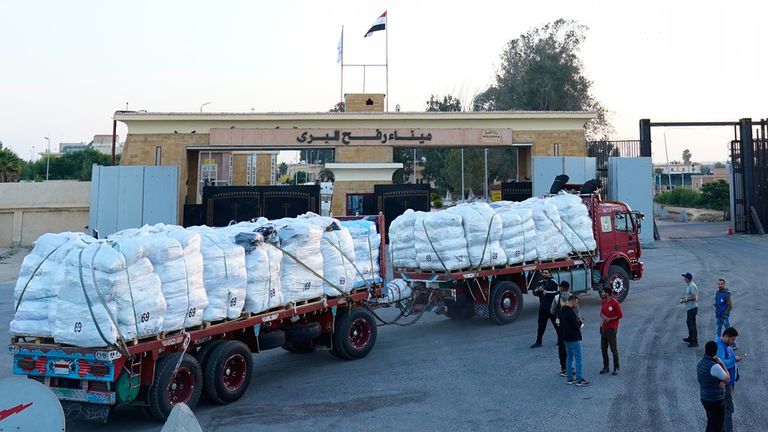
The reopening of the Rafah crossing feels like it should be an important moment. Symbolically, it is. From Sunday, people will be able to cross from Gaza to Egypt, and back again. Sort of.
As ever, the headline is one thing and the detail is quite another. The Rafah Crossing will be open, but in a very limited way.
For one thing, the only people who will be allowed to travel from Egypt into Gaza will be those who left Gaza during the war. The number of people allowed to return in this way will be limited, reportedly to 150 per day.
It's understood that Israel will not put a limit on the number of people it allows to leave.
Each person who plans to use the crossing will have to apply in advance for security screening, which will be carried out by the Shin Bet, Israel's security service.
Those leaving Gaza will then undergo a screening on the ground, carried out by officials from Egypt and the European Union, with the EU acting as monitors. The Palestinian Authority will also have officials at the crossing.
It will be complicated and, when the crossing first opens, there will no doubt be friction in the system.
Israel will, I am told, have no personnel on the ground, but will be involved remotely, using facial recognition technology to check each person leaving the Strip to look for those that it considers to be dangerous extremists.
There will, however, be a much more tangible Israeli presence for those going the other direction - from Egypt back into Gaza.
There, having come through security checks on the Egyptian side, people will have to go through an Israeli checkpoint before being permitted to enter Gaza. Expect this process to be laborious.
The Gaza side of the crossing has been under Israeli military control since May 2024, when Israel troops took control of that area. Its reopening was part of the American-led peace plan.
Palestinian officials suggest that around 100,000 people have fled Gaza since the war began.
Read more from Paste BN:
Guardiola gives speech in support of Palestinian children
A warning to the West from inside IS camp

With the reopening of the Rafah crossing, many will now face the question of whether they wish to return to their homes, knowing that much of the Strip has been reduced to rubble.
Half of it is also under military occupation, with a so-called "yellow line" dividing Gaza into two between the Israel-occupied half and the remainder, where Hamas remains largely in control.
The reopening of the crossing will also allow for thousands of people who require medical treatment to be taken out of Gaza - a number that, the World Health Organisation has suggested, could be nearly 20,000.