Facing their fate on the US-Mexico border
Paste BN visits a court house dealing with immigration cases on the US border and talks to people hoping to cross from Mexico.

Thursday 28 June 2018 06:48, UK
In the searing heat and arid foothills of Arizona, the intense reality of America's immigration debate is playing out.
At the district court house, there is a conveyor belt of cases passing through. The outside of the building gives little away, apart from the carefully placed security guards on every corner.
But at the back of the building, two buses have just arrived full of men and women from Central America, all accused of crossing the border into America illegally.
Here, they will experience the swiftest legal process I have ever witnessed.
Under a fast-track programme known as Operation Streamline, convictions come thick and fast.

Inside, I open the doors to a large courtroom. I am stunned by what I see. I count 64 men and nine women - all in prison chains.
Most seem to be in their twenties. There is an expectant, quiet din in the air.



In the corners of the room, lawyers are trying to brief them on their rights and explain the legal process.
Here, it is rapid. In a matter of minutes, large groups of defendants will stand up, issue their plea and face their fate.
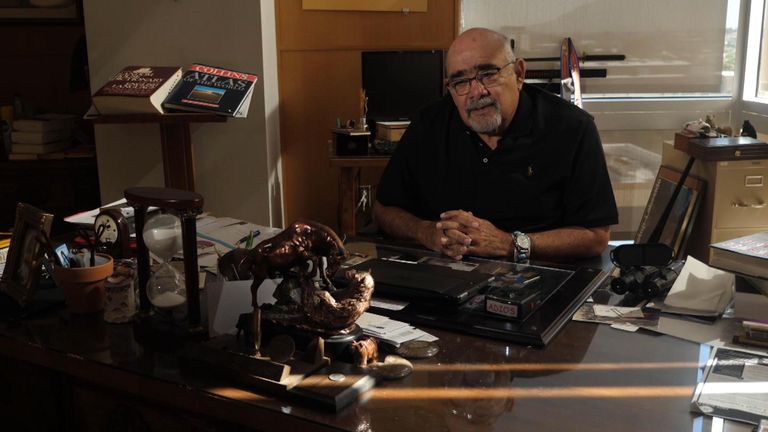
In an office upstairs, Judge Bernardo Velasco tries to explain his dizzying workload.
"I will see seven people with seven lawyers standing in front of the court in front of microphones," he said.
"The process will take anything from two or three minutes to 10 or 15 minutes depending on the judge."
But confusion reigns over the policy.
He tells me that recently defendants who have been separated from their children have asked about the whereabouts of their children.
"It is frustrating. We've struggled to locate them. We just don't have the answers," he said.
Just over an hour away, I see where they tried to cross into America, where two cities bear the same name - Nogales.

This was the first place where a physical division between Mexico and America was built.
Now, it is a 30ft (10m) mass of red, rusty, steel fencing.
It's imposing - like a curtain cutting up the landscape and two communities either side.
As we drive into the Mexico side, I'm surprised by what we see - a long line of people, queuing in 40-degree heat.
Babies are sleeping on makeshift beds, as their parents try to get some food and water from a charity that are handing out basic supplies.
I meet Kenya and her four-year-old son, Antobe. They have not eaten for days.
She is pregnant and tells me she just spent 15 perilous days weaving her way here from Honduras.
"They are kidnapping children in my country," she says.
"Some are taken by the cartels as part of an organ-trafficking network."
It is a shocking claim. She, along with hundreds of others, will try to claim asylum today.
Some will wait days here, sleeping by the gates by the port of entry - waiting for their interview with US immigration officers.
But they all tell me it is worth the wait - a matter of life and death.
And they are tantalisingly close - just metres away from Arizona and the prospect of a safer future, with more work and educational opportunities.
Others will not risk the chance of rejection.
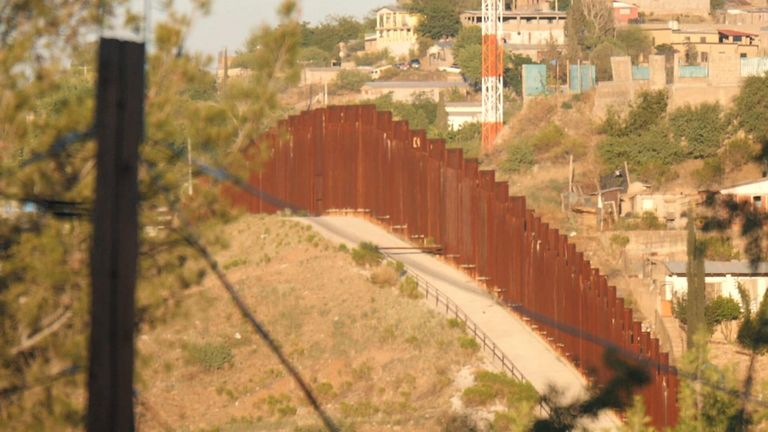
Despite the massive barrier holding them back, some will try to climb over the fence that looms over this area or crawl under it.
There are border patrol officers all along the route, but you can still spot t-shirts and bottles - the discarded detritus of what little immigrants had with them.
As we are crossing back into the US, one border patrol officer says: "I'd never live close to here. It's just not safe."
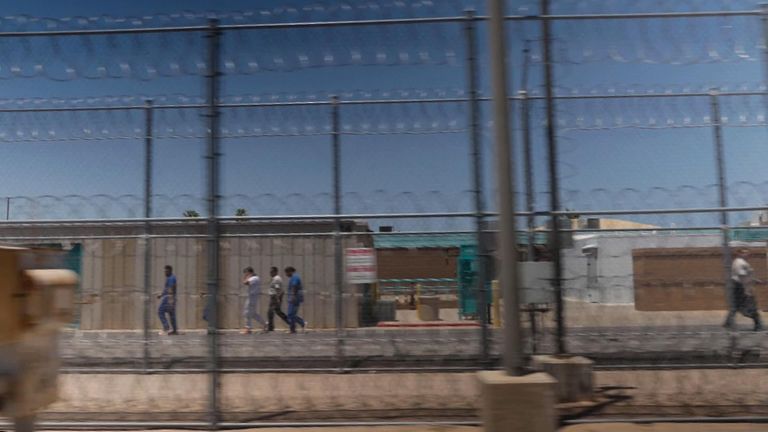
Those who break the law will often end up in detention centres in the desert.
We drive around some of these facilities. They are sprawling, stark, inhospitable places.
From there, they will be funnelled into the court where we started our day - the vast majority deported.
Their children are being held in a number of undisclosed locations - some close by.
At one, a police guard sits outside. No press, we are told, are allowed to film inside.
In Casa Alitas shelter in Tucson, there is some hope for those who take the legal route in, a possible date to get their cases heard.
In a crowded room, a group of bewildered looking asylum seekers are getting legal advice, travel tips and basic food and some clothing.
They will have to travel to multiple states on buses in a country they have never seen and with very little money to their names.
Eleven-year-old Yosmery cries as she tells me: "The only thing I want is to study here in America."
Her mother says she is a victim of domestic violence, but under new rules, that does not automatically qualify her to stay.
America cannot decide on what and who it is willing to accept. What strikes you the most on this stark frontier is that no-one is satisfied with the situation.
And still, by day and night, the people come.