Boston Marathon Explosions On Social Media
The deadly explosions at the Boston Marathon show there are two sides to the social media coin.

Tuesday 16 April 2013 10:52, UK
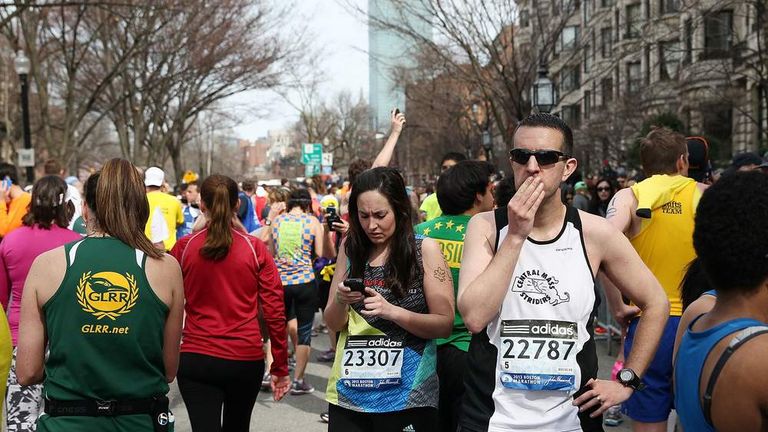
The explosions that shook the finish line of the Boston Marathon revealed the best and the worst of social media.
Even before the dust had settled, spectators and competitors had taken to social media to report the twin blasts - and the scenes of carnage they had caused.
Twitter came alive shortly before 8pm (British time), first with sketchy reports of loud bangs and clouds of smoke; later, with photos and video which clearly showed their tragic human cost.
It also became a useful communications tool for the police and marathon organisers, warning people to leave the area and not to gather in large groups.

Boston PD’s twitter feed gave minute by minute updates. Followers could see in real time the advice from emergency services, and keep abreast of rumoured secondary devices.
Journalists on the ground, many of whom were only there to cover the marathon itself, could, without access to a broadcast camera or satellite truck, report live from the scene via their smartphones and social media apps.
In the moments after the explosions, these first-hand accounts were invaluable in alerting the world to the fact this was a terrorist attack, and not some freak accident.

One Boston Redditor created a page, "There was just an explosion at the Boston marathon" which compiled tweets, media reports and other useful links.
It was from there, for example, that many people were led to a webpage which allowed users to monitor emergency services radio frequencies, or the Massachusetts page of the American Red Cross website detailing blood banks across the city where donations could be made.
And, as with the earthquake in Japan, Google set up a People Finder to help users connect with family and loved ones in the aftermath.
Yet social media is, largely, unfiltered and unmediated. Graphic images of the injured flooded Twitter, as did inaccurate or downright false reports.
Mobile phone networks were said to have been shut down to prevent further remote detonations - yet Verizon, AT&T and Sprint Nextel denied this, claiming that the networks were simply experiencing "capacity issues".
A Twitter account, @bostonmarathon, promised to donate $1 to blast victims for every retweet they received. It was a fake.
As the blasts in Boston have shown, there are two sides to the social media coin.
The first, that its speed and ease of use can get information out to a wider audience practically in parallel with the events they describe.
The other, that everything one reads from an unconfirmed or unknown source needs to be checked for accuracy.
As Twitter user @rolldiggity said: "Twitter does its best work in the first five minutes after a disaster, and its worst in the twelve hours after that."