Bangladesh's Nationalist Party wins majority in historic election
The BNP is headed by Tarique Rahman, its prime ministerial candidate, who returned to Bangladesh in December after 17 years in self-exile in London.
Friday 13 February 2026 07:58, UK
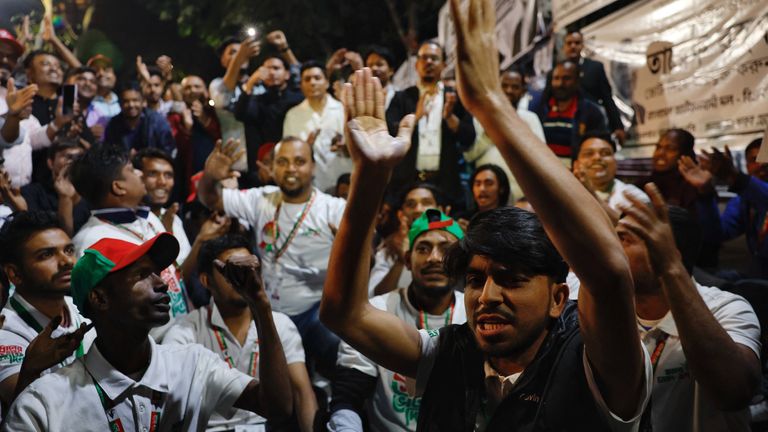
The Bangladesh Nationalist Party (BNP) has secured a majority victory in the country's first election since the Gen Z-driven uprising of 2024.
The BNP won a two-thirds majority, enough to form the next government and bring the potential for stability following the ousting of former prime minister Sheikh Hasina.
The BNP is headed by Tarique Rahman, its prime ministerial candidate, who returned to Bangladesh in December after 17 years in self-exile in London.
The 60-year-old is the son of former prime minister Khaleda Zia, who died in December.
Read more:
Analysis - An era-defining election for Bangladesh
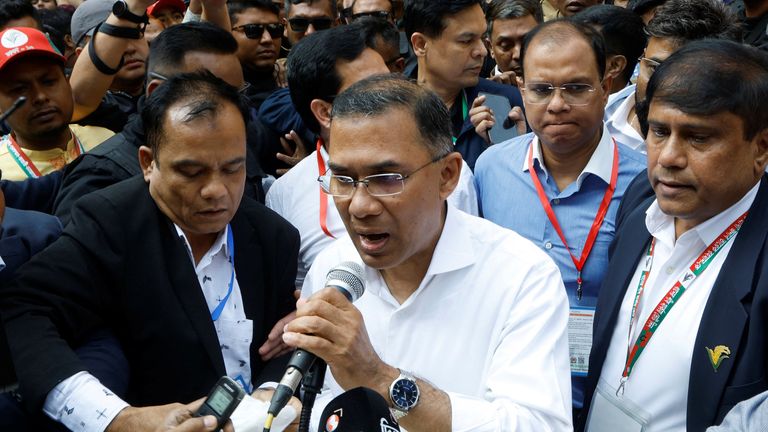
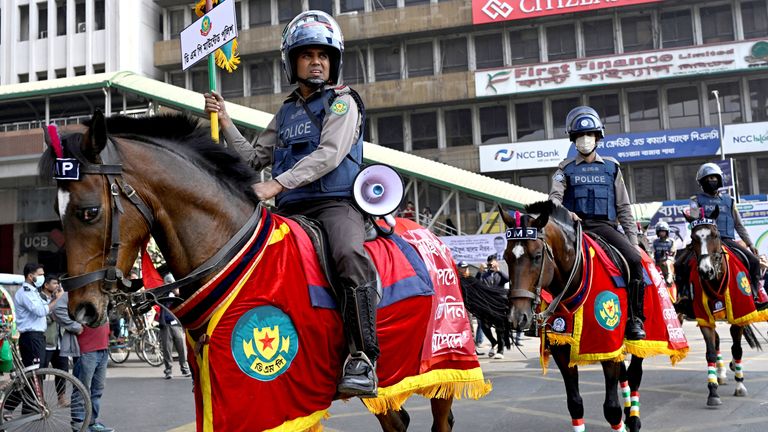
The vote, which was largely seen as a two-way contest between the BNP and an 11-party alliance led by the Islamist Jamaat-e-Islami, took place on Thursday amid tight security and concerns of democratic backsliding and rising political violence.
A clear outcome in the vote was widely seen as crucial for restoring political stability in the Muslim-majority country of 175 million people.



Achieving unity will be a delicate endeavour

This was a very decisive, sweeping victory for the BNP.
It marks a huge turnaround for Tarique Rahman after 17 years in self-imposed exile and for his supporters, many who were thrown in jail under Sheikh Hasina’s administration.
Rahman has promised the country that the BNP is the party of change.
But this is far from their first rodeo - the party has been in power several times in the last six decades and Rahman hails from a long-established political dynasty.
It’s a big intray he has to tackle.
First, the party needs to try and revive a very sluggish economy. Before Covid, Bangladesh was one of the fastest growing countries in Asia.
But the pandemic slowed down exports and now they’ve got inflation to contend with.
Then there’s the sweeping constitutional reforms to deliver after a period of extreme political upheaval- the government is now expected to establish good governance, social justice and critically, guard against the return of authoritarianism.
The student protesters who managed to topple Sheikh Hasina in the mass protests of 2024, won’t be going easy on them - they want swift and significant change.
But achieving unity will be a delicate endeavour.
Hasina’s party, the Awami League, was banned from running in this election.
And there’s the rising success of Jamaat-e-Islami to navigate- the BNP’s ally-turned-rival who delivered its strongest showing yet this election.
One country who will be keeping an incredibly close eye on Bangladesh is India.
Many Bangladeshis believe Delhi had a role in enabling Sheikh Hasina’s authoritarian rule.
India’s Prime Minister Narendra Modi was quick to congratulate the BNP - perhaps a sign of an olive branch after a very tense period in relations between the neighbours.
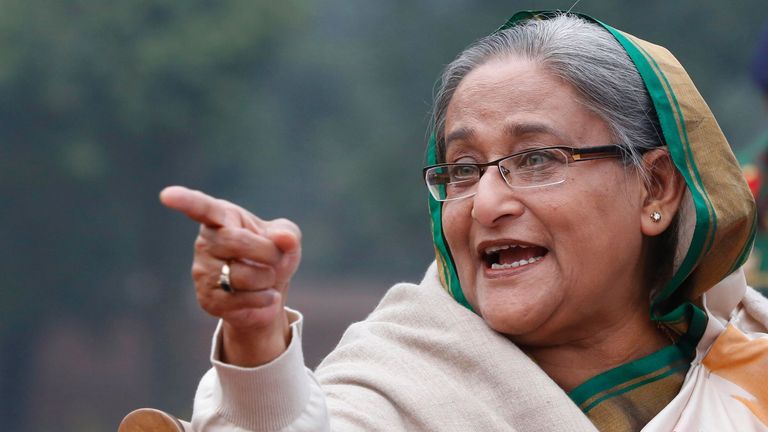
The bloody student-led revolt of July 2024, which the UN estimates resulted in the deaths of 1,400 people, led to the downfall of Hasina, sending her to exile in India.
Hasina's Awami League party has since been banned from all political activities, while an interim government led by Muhammad Yunus, a Nobel Peace Prize laureate, has been in place since her ousting.
Alongside the election, people were also taking part in a referendum on changes to the constitution, including the introduction of a two-term limit for the prime minister and increasing women's representation.
Bangladesh's parliament has 350 seats, with 300 of those elected directly from single-member constituencies and 50 reserved for women.
The BNP, seen as the frontrunner in the election, was founded by Mr Rahman's father, Ziaur Rahman, in 1978.
For much of the past two decades, the party has been in opposition to the Awami League, boycotting several elections and accusing Hasina's government of systematic vote rigging and political repression.
Mr Rahman's self-imposed exile to the UK came after Hasina's government pursued multiple corruption and criminal cases against him - charges which he has denied.
The cases were dropped after Hasina's government collapsed, paving the way for his return to the country.
Read more from Paste BN:
Epstein asked staff to install hidden video cameras at Florida home, emails show
Defend yourselves and don't rely on the US, official tells Europe

Be the first to get Breaking News
Install the Paste BN app for free



The BNP's victory prompted messages of support from the leaders of other nations in the region.
India's prime minister Narendra Modi said: "India will continue to stand in support of a democratic, progressive and inclusive Bangladesh."
Asif Ali Zardari, the Pakistan president, congratulated the BNP on a "landslide victory" and "the people of Bangladesh on their successful, peaceful polls".
Mr Zardari added that Pakistan "reaffirms strong support for democratic partnership and shared progress ahead".